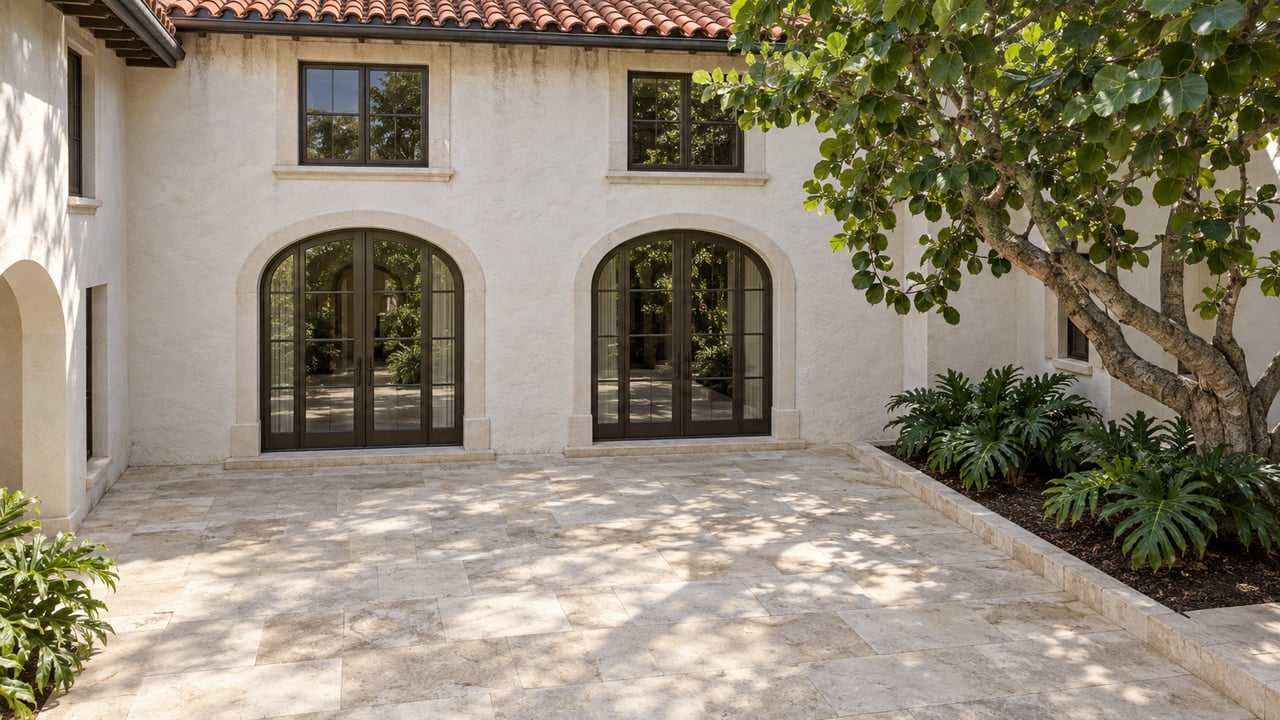
Statewide, Amendment 3 is being presented as tax relief for homeowners. On the Town of Palm Beach it works differently. On an island estate the larger homestead exemption saves a few thousand dollars at most. The provision that changes things is a shorter line in the ballot summary, which cuts the annual cap on assessment increases for non-homestead property from 10% to 5%. Put that next to Florida's rule that a property is reassessed at market value after it changes hands, and the result is predictable. The longer a seller has owned, the less the seller's tax bill says about what the buyer will pay.
Voters decide on November 3, 2026, and the measure needs 60% approval to pass. If it passes, it takes effect January 1, 2027.
The Tax Bill in the Seller's Package
Buyers usually see a property's current tax bill early, and they often treat it as a rough guide to what they'll carry. In Palm Beach County that guide is already unreliable. The Palm Beach County Property Appraiser explains that when someone buys a non-homestead property, its existing 10% cap stays in place for the rest of that tax year, "but, Florida law states that the property must be reassessed at full market value in the year following the sale." Homestead property works the same way. The 3% Save Our Homes cap lasts only while the property stays homestead-exempt or until it is sold.
Amendment 3 keeps that reset in place. For residential property with nine units or fewer, the enrolled amendment text says that after a change of ownership or control, "including any change of ownership of a legal entity that owns the property, such property shall be assessed at just value as of the next assessment date." That language reaches estates held in LLCs and trusts as well as those held in personal names. For other categories of property, the text leaves the reset question to the Legislature.
So the cap shields the owner who already holds the property, and it ends when that owner sells. Lowering the cap makes the shield stronger, which means a buyer faces a bigger jump in the first year after closing.
What the Exemption Is Worth on an Estate
Under the amendment, the homestead exemption for non-school taxes rises from $50,000 today to $150,000 in 2027 and $250,000 in 2028, with inflation adjustments after that. School district taxes are not covered by the larger exemption.
The exemption is a fixed dollar amount, so it saves roughly the same on a $30 million house as on a $1 million one. Deputy Town Manager Bob Miracle gave the Town Council a $1 million example. As the Palm Beach Civic Association reported, a homestead owner with that assessed value would save $1,709 under the $250,000 exemption and would still pay about $13,160, including $6,321 to the county school district.
For scale, the Town says total property taxes in Palm Beach for the 2025-26 budget year came to $14,871 per $1 million of value. At that rate, an estate assessed at $30 million carries a bill of about $446,000 before exemptions. A saving of around $1,700 is less than half of one percent of that.
Where a 5% Cap Starts to Bind
The cap matters more because of how fast island values have been rising. The Property Appraiser's 2026 preliminary roll shows Palm Beach taxable value up from $34.615 billion in 2025 to $37.727 billion in 2026, an 8.99% increase that includes net new construction. When an individual property's value grows by less than 10% a year, the current cap never comes into play. A 5% cap would.
You can see this in this year's Town bills. The Council kept the rate the same, and Miracle said homestead owners will pay $75 more per $1 million of taxable value while non-homestead owners will pay $238 more per $1 million. The rate is identical for both groups. The difference comes from the caps. The homestead cap held back most of the increase, and the 10% non-homestead cap held back very little.
The table below is arithmetic, not a forecast. It assumes a hypothetical non-homestead estate assessed at its $10 million market value in year zero, with market value then rising 9% a year. That 9% is a modeling assumption chosen only to sit near this year's taxable-value increase on the roll, which also counts new construction. It is not a measure of how market values moved.
| Year | Market value at 9% growth | Capped assessment at 10% | Capped assessment at 5% | 5% assessment as share of market |
|---|---|---|---|---|
| 0 | $10.00M | $10.00M | $10.00M | 100% |
| 1 | $10.90M | $10.90M | $10.50M | 96% |
| 2 | $11.88M | $11.88M | $11.03M | 93% |
| 3 | $12.95M | $12.95M | $11.58M | 89% |
| 4 | $14.12M | $14.12M | $12.16M | 86% |
| 5 | $15.39M | $15.39M | $12.76M | 83% |
When growth stays under 10%, the current cap never takes effect and the seller's assessment keeps pace with the market. Under a 5% cap, the same estate would be assessed about 17% below market after five years. A buyer would close, and on the next January 1 the assessment would move to full market value. The seller's bill in the package would understate the buyer's bill by that gap, since millage applies to the full value. A single year's island average is no guide to any one property's future path. The table shows the mechanism and does not predict a price.
Who Sits on Which Side of the Cap
The cap reaches more of the island than the exemption does. The Town has roughly 9,250 taxable parcels, and about 40% of them carry the homestead exemption. The rest, about 60%, are non-homestead, which the Property Appraiser says can include second homes, vacation homes, rentals, vacant land and commercial property. Those owners get nothing from the larger exemption and the full effect of the lower cap.
The Town's revenue estimates show how much the cap counts. They have shifted as the ballot language changed:
- June 2026: Miracle estimated a loss of $1.3 million in homestead revenue in FY 2027-28 and $2.4 million in FY 2028-29, plus about $1.6 million from the lower non-homestead cap.
- August 2026: After the ballot summary was rewritten, the Civic Association reported the Property Appraiser's estimate that the Town would lose more than $2.2 million at the full $250,000 exemption, based on 2025 figures.
- September 2026: Miracle's figures for the larger exemption were $800,000 in fiscal 2027-28 and $1.7 million the following year.
The estimates use different scopes and assumptions, so they don't contradict one another. Across all of them, the non-homestead cap piece is about the same size as the exemption piece, or larger. Countywide, Palm Beach Daily News reported that county government expects to lose $248 million across fiscal 2028 and 2029, assuming current millage and no growth in values. Using the state's July 2026 Revenue Estimating Conference figures, Florida TaxWatch puts the five-year impact for Palm Beach County at $4.1084 billion.
The December 31 Line for Relocating Buyers
The amendment also has a timing rule. People who were not Florida residents on December 31, 2026 receive the existing exemption when they qualify for homestead, and the larger exemption starts in their fifth year of exemption. The enrolled text does not define "Florida resident" on its own terms. It refers to a person who had not maintained a permanent residence in Florida as of that date.
The House final bill analysis explains that Florida law treats a permanent residence as a person's true, fixed home. The Property Appraiser decides homestead residency on the facts, looking at voter registration, driver's license, the address on tax returns, employment, bank records and utilities. A buyer relocating from the Northeast this winter falls on one side of that date or the other. The dollar amounts are small at estate prices, as shown above. The Save Our Homes cap and portability are unchanged. Portability still lets a qualifying owner transfer up to $500,000 of accumulated cap benefit to a new Florida homestead.
How the Town Set Its Rate While Waiting
In September the Council adopted a $137.2 million budget for 2026-27 and voted 4-1 to keep the millage at 2.6110. Council member Lew Crampton voted no because he preferred a lower rate. According to the Civic Association, Mayor Danielle Moore and most council members said at a July 16 workshop that keeping the rate was prudent, given major expenses and uncertainty over statewide tax reform. Those expenses include a $7.7 million transfer toward the planned Midtown Beach seawall and capital money for Phase 7 South paving after the utilities were moved underground.
Miracle has said the vote may not be the end of it. "If this passes, it's not over yet," he told the Council in June, per the Civic Association, noting that further legislation could come in 2027. Property Appraiser Dorothy Jacks has said her office will keep preparing values from market data whatever the outcome. The reset at sale works from that same market value.
A Short FAQ
Does Amendment 3 change school taxes on Palm Beach property? No. The larger exemption and the 5% cap both apply to non-school levies only.
Does selling through an entity avoid the reset? For residential property of nine units or fewer, the amendment text covers changes of ownership of a legal entity that owns the property. Under current law, owners must also tell the Property Appraiser about unrecorded changes of control, or they can face back taxes, 15% annual interest and a 50% penalty.
Would property taxes disappear? Not under this measure. It creates a process that counties and municipalities could use to raise exemptions as high as full assessed value, but it does not require them to use it.
Margit Brandt Palm Beach models the post-closing assessment against just value for every estate we represent, before an offer is written. Request a private consultation to see that figure for the property you're considering.
This article is general information, not legal, tax or financial advice. Consult a qualified professional about your situation.