How does a billionaire sell a building on the most expensive shopping street in Florida and walk away with almost nothing to show for it?
That is the question sitting inside a deal that closed earlier this month. Ken Griffin, the Citadel founder, agreed to sell his three-story building at 125 Worth Avenue to Blackstone's Revantage platform for $86 million. He bought it in 2023 for $83 million. On paper that reads as a $3 million gain. Once you account for the brokerage fees and closing costs that come with a deal this size, The Real Deal reported the real return is closer to zero, and possibly a small loss.
For a man estimated to be worth somewhere between $37 billion and $50 billion, that is a rounding error. But it raises a real question for anyone trying to read the Palm Beach market from the outside. If trophy real estate here is supposedly on fire, why did one of the most sophisticated investors in the country sell at a wash?
A billionaire's second wash of the year
This was not Griffin's first near break-even exit on Worth Avenue. In November 2025 he sold the 48,600 square foot former Neiman Marcus building at 151 Worth Avenue to TZ Capital, the West Palm Beach investment firm backed by the family office of GoldenTree Asset Management founder Steven Tananbaum, for $80.5 million. He had paid $78 million for it in 2022. Two properties, two modest sales, two deals that generated more headlines than profit.
Griffin still holds the larger prize: a 17.7-acre residential assemblage on South Ocean Boulevard that he has spent more than $350 million acquiring. The Worth Avenue dispositions look less like a retreat from Palm Beach and more like a shift in what kind of asset he wants to hold there.
The building itself tells its own story. Built in 1974, the roughly 49,000 square foot property houses Truist Bank and yacht brokerage Ferretti Group on the ground floor. Blackstone's $86 million works out to about $1,720 per square foot, a price that would draw attention almost anywhere else in the country for a 52-year-old office and retail building. On Worth Avenue this summer it barely registered as news beyond the trade press.
"High-street retail continues to experience strong fundamentals, and Palm Beach represents one of the highest performing luxury retail markets in North America," Blackstone Real Estate principal Elena Clarfield said in a statement announcing the deal.
Three deals, one signal
Griffin's sale did not happen in isolation. It capped a run of institutional buying on Worth Avenue that started in March 2026, when Reuben Brothers and Crown Onyx paid $200 million for the Esplanade at 150 Worth Avenue, the two-story, 128,779 square foot complex anchored by Carolina Herrera, Emilio Pucci and Hublot. That price made the Esplanade the most expensive single property sale in the town's history, commercial or residential, and represented an 88.7 percent gain over what O'Connor Capital Partners paid for the same building in 2014.
Days later, Acadia Realty Trust closed on 225 Worth Avenue, leased to Gucci, J. McLaughlin and G/FORE, for $43 million. That works out to $4,329 per square foot on a 9,932 square foot building, more than double what the property sold for five years earlier.
| Property | Buyer | Price | Price per sq ft | Closed |
|---|---|---|---|---|
| 150 Worth Ave (The Esplanade) | Reuben Brothers / Crown Onyx | $200 million | not disclosed | March 2026 |
| 225 Worth Ave | Acadia Realty Trust | $43 million | $4,329 | March 2026 |
| 125 Worth Ave | Blackstone / Revantage | $86 million | $1,720 | August 2026 |
| 151 Worth Ave (former Neiman Marcus) | TZ Capital | $80.5 million | not disclosed | November 2025 |
Four buyers, four different price points per square foot, and one consistent explanation from the people arranging these deals. Brittany Feinberg of Adirondack Capital Partners, who brokered the Acadia deal, put it plainly in a statement carried by citybiz: "Worth Avenue has emerged as a top-tier institutional trophy corridor. The massive influx of ultra-high-net-worth residents and businesses relocating to Palm Beach has fundamentally transformed the demand profile for retail here."
The numbers behind that statement are stark. Palm Beach retail carries a vacancy rate under 1 percent, with rents approaching $92 per square foot, according to a Cushman & Wakefield report cited by Bisnow. Palm Beach County as a whole runs under 4 percent vacancy at rents closer to $39 per square foot. Countywide commercial investment sales reached roughly $690 million in the first half of 2026, the second busiest first half on record and the highest since 2022.
The same math, wearing a house instead of a storefront
None of this is really a story about retail. It is a story about what happens when a fixed strip of land, eighteen miles long and never more than three-quarters of a mile wide, keeps absorbing capital that has nowhere else on the island to go. Worth Avenue's storefronts are the most visible version of a dynamic playing out across the island's residential streets too.
That dynamic explains something that trips up buyers comparing Palm Beach to other markets: the residential price data does not agree with itself this quarter. One widely cited figure puts the three-month median sale price for the town of Palm Beach at $2.6 million as of May 2026, down 23.6 percent year over year. A separate brokerage report for the same quarter puts the island's median flat at $2.2 million, unchanged from a year earlier, alongside a 41 percent drop in closed sales and inventory down 12 percent to just 289 properties. A third report focused on the barrier islands found the opposite story at the top of the market: single-family median price up 18 percent to $15.4 million, average price up 11 percent to $17.9 million, and closings above $20 million doubling from the prior year.
Three reports, three medians, three different directions. That is not one of them being wrong. It is what happens when a market has so few transactions that a handful of closings at the very top, or their absence, can swing the reported number by millions of dollars in either direction. An island carrying an active inventory of well under 300 properties does not behave like a market with thousands of listings. The median there is a headline, not a signal.
Why the median lies to you here
The mistake buyers make when they pull up a chart of median sale price for Palm Beach is treating it like the same statistic in a market with thousands of monthly transactions, where a median smooths out the noise and tells you something real about direction. Here, one $30 million estate closing or not closing in a given quarter can move the number more than the underlying market actually moved.
What the Worth Avenue transactions show is the metric that actually holds steady: scarcity. Vacancy under 1 percent. Rent growth well ahead of the rest of the county. Institutional buyers willing to pay $1,720 to $4,329 per square foot for buildings that will never generate a yield that justifies the price on paper, because the yield was never the point. The point is owning a piece of a corridor that cannot be replicated.
The same logic applies to a beachfront lot on the island or an estate in the historic in-town core. The relevant question is not whether last quarter's median moved up or down. It is whether the specific type of property you want, waterfront, walkable to Worth Avenue, on a short list of streets with real name recognition, is getting harder or easier to find. On the current evidence, it is getting harder.
What this means if you are pricing a move this fall
For a buyer watching the headlines, a falling median is not permission to wait for a broader correction. The properties pulling the median down are often just the ones that happened to close, not evidence that comparable properties are getting cheaper. For a seller, the lesson from Worth Avenue is more direct. Buyers with real capital are not shopping by price per square foot against some abstract benchmark. They are buying because the asset cannot be recreated, and they are willing to pay a premium for that fact even when, as Griffin's numbers show, it does not guarantee a profit on resale.
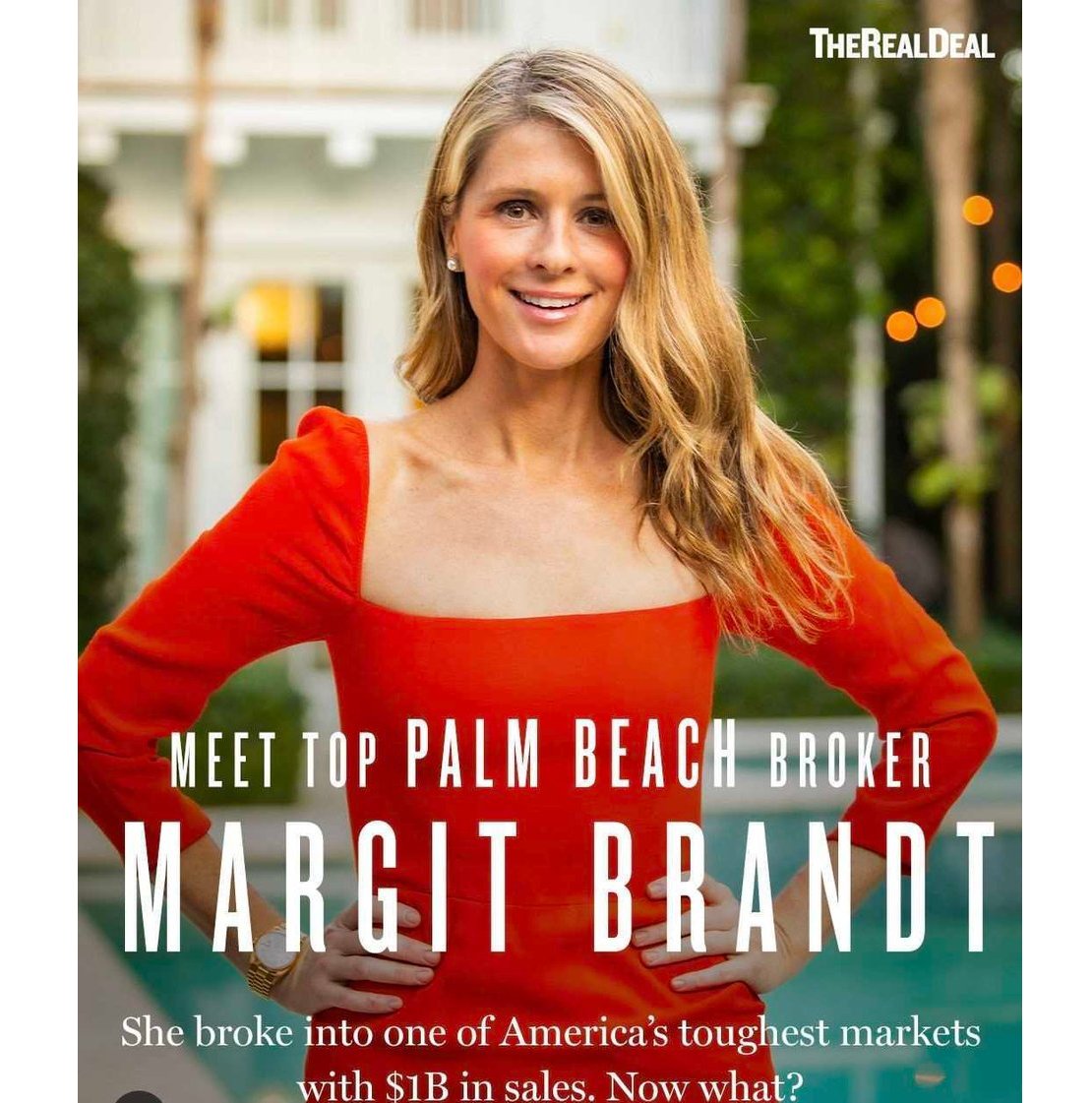
That distinction matters most at the tier where Margit Brandt Palm Beach spends its time: island estates, waterfront trophy properties, and the kind of assets that rarely see the open market at all. Off-market activity above $30 million continued through the first half of 2026 even as public sale counts fell, a pattern consistent with what the Worth Avenue deals suggest about where real demand is concentrated.
A short FAQ
Does the Worth Avenue buying spree affect home values on the rest of the island? Not directly and not immediately. Commercial and residential real estate are separate markets with separate buyers. What the retail deals demonstrate is the underlying scarcity premium that also applies to residential property in the same corridor, which is a useful lens for interpreting price behavior rather than a direct price driver.
Should I wait for the median price to bottom out before buying? Given how few transactions occur on the island in any given quarter, a declining median can reflect which properties happened to close rather than a shift in underlying value. Watching inventory and vacancy trends tends to be a more reliable signal than a single quarter's median in a market this thin.
Is off-market activity common at this price tier? Yes. Sales above $30 million on the island continued through 2026 even as publicly reported transaction counts declined, consistent with how much of the top tier of this market transacts away from public listings.
Reading a single median price in Palm Beach is like reading one wave and calling it the tide. If you are weighing a purchase or a sale at this level of the market, Margit Brandt Palm Beach works these transactions daily, on and off market alike. Request a private consultation to talk through what the current numbers actually mean for your specific position.