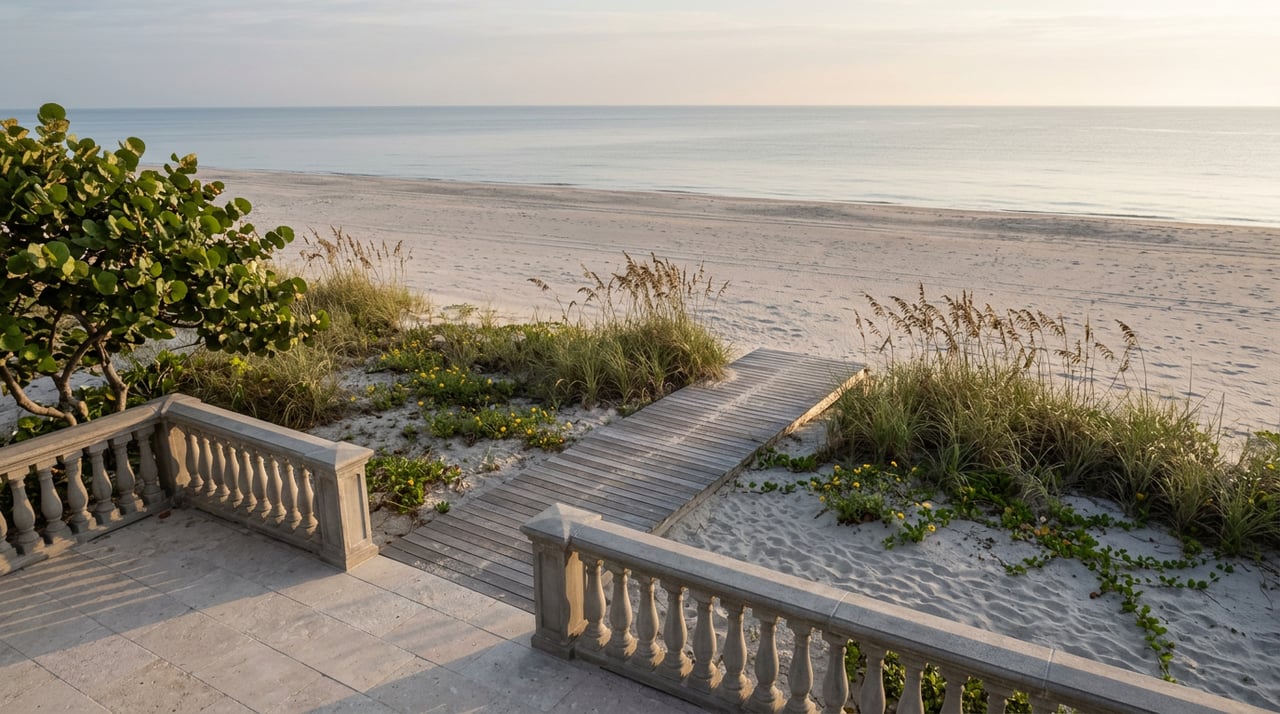
Walk Midtown Beach at dawn this month and you'll see them: wooden stakes driven into the sand at odd intervals, sometimes ringed with orange tape, sometimes just standing alone against the tideline. Nobody explains them to you. They're simply part of the September beach, the way the lifeguard stands and the raked sand are part of it. But this year the stakes are telling a more specific story than most residents realize, and the headline number everyone quotes only gets you half of it.
By the end of July, the town's own sea turtle monitor had counted roughly 6,100 loggerhead nests on Palm Beach, up from about 5,700 over the same stretch last year. Say that number out loud and it sounds like a banner season. It isn't quite. Green sea turtle nests fell to around 150 this year, down from 400 last season, a drop of nearly two thirds. Leatherbacks, meanwhile, nearly doubled, climbing to about 150 nests from 85. Add the three species together and the running total of roughly 6,335 nests was still shy of the same point last year, when the count stood near 6,600. The loggerheads went up. The overall picture went down. Both things are true at once, and the second one rarely makes it into the summary.
What the Stakes Are Actually Counting
The counting itself is a genuinely local operation. Palm Beach's nests are tracked by DB Ecological Services, a firm headquartered right here in town, and it's principal, Christine Perretta, who has been supplying the numbers to the Daily News all season. Her read on the year so far is measured rather than triumphant.
"Everything is tracking really nicely."
That's not the language of a record year. It's the language of a normal one, and normal is worth defining here, because the last time Palm Beach had a genuinely exceptional loggerhead season was 2023, when the town tallied roughly 8,400 nests, a figure Perretta herself has called an outlier rather than a new baseline. Measured against 2023, this season looks soft. Measured against a typical year, it looks solid. The stakes you're stepping around on your walk this week represent an above-average but unremarkable season for loggerheads, propped up by a leatherback surge, sitting alongside the weakest green turtle turnout in recent memory.
Why greens fell so sharply this particular year isn't something the local data explains on its own. Green sea turtles nest in a pronounced multi-year cycle, often skipping seasons in ways loggerheads don't, so a down year for greens doesn't necessarily forecast anything about next season. It does mean that anyone who spent last September watching green turtle hatchlings emerge near their stretch of sand should expect a quieter version of that same experience this fall.
Two Beaches, One Coastline, Different Stories
If you've seen coverage describing 2026 as a record-breaking year for sea turtles in this part of Florida, that reporting is accurate. It's also describing a different beach.
Boca Raton, roughly twenty miles south, is having a historic season. By early July the city had already logged a record 43 leatherback nests, ten more than the previous record set in 2012. Loggerhead nests there hit 1,077, breaking a 36-year-old record by two nests, the previous mark having stood since 1990. Those are genuinely extraordinary numbers for that stretch of shoreline.
Palm Beach, meanwhile, is not having that year. Same coastline, same species, same eight-month season, and two towns twenty miles apart are producing opposite headlines. Sea turtle nesting is famously beach-specific behavior. Females tend to return to nest near where they themselves hatched, which means the animal-by-animal math of one town's beach can diverge sharply from its neighbor's even when regional press treats the whole 47-mile Palm Beach County coastline as a single story. Florida as a whole remains one of only two places on earth, alongside the coastline of Oman, that see more than 10,000 loggerhead nests in a single year, and the state accounts for roughly 90 percent of all loggerhead nesting in the Northwest Atlantic population. That scale is real. It just doesn't distribute evenly, town to town, and Palm Beach's 2026 sits closer to the modest end of that range than Boca Raton's does.
The Rules You're Already Living With
None of this is abstract wildlife trivia if you own or rent anything within sight of the water. The town's shielding of light ordinance, which requires oceanfront property owners to keep artificial lighting from being visible on the beach, has been in effect since March 1 and runs through October 31, meaning it still has close to eight weeks left to run. Hatchlings orient toward the brightest light on the horizon, which for millions of years was moonlight on open water. Porch lights, pool lights, and unshaded windows can pull them the wrong direction entirely, so the ordinance isn't a seasonal decoration. It's the reason your neighbor's oceanfront lanai has looked dimmer than usual since spring.
The same logic extends to how you use the beach itself, and the town has been explicit about a few points this season:
- Dogs may run off leash on the beach between Sunset Avenue and Wells Road, but only from dawn until 9:00 a.m. After that window, leashes are required, a rule the town ties directly to protecting nesting turtles and shorebirds during the season.
- Nest stakes and taped-off areas are off limits regardless of how empty the sand around them looks. Most nests aren't marked at all, so an unstaked stretch isn't necessarily an unoccupied one.
- Chairs, umbrellas, and other equipment should come off the sand before dark, since a nesting female that meets an obstacle she can't crawl around will often turn back to the water without laying at all.
- Any hole dug during the day should be filled back in before you leave. A hatchling that falls into an unfilled hole on its way to the water can spend a fatal amount of time getting out of it.
These aren't abstractions borrowed from a county pamphlet. They're the specific terms under which this town's beaches operate for eight months a year, and this is the stretch where they matter most.
What Changes Between Now and Halloween
Sea turtle eggs generally need about two months underground before they're ready to hatch, which is the detail that makes September the season's payoff month rather than its afterthought. Nests laid in July and August are the ones working their way to the surface right now, and activity should continue through the end of October, when the season officially closes.
That timing cuts against the instinct to treat nest counts as a spring and summer story that's essentially over by Labor Day. It isn't. The stakes on Midtown Beach this week are more likely to represent eggs actively incubating toward emergence than fresh nests still being laid, which means the coming weeks are genuinely the best window all year to notice hatchling tracks at dawn, the fan-shaped scatter marks leading from a nest to the waterline. Given how far green turtle nests have fallen this season, though, don't expect as many of those tracks to be theirs. The loggerhead hatchlings should carry most of the traffic this fall, the leatherbacks will contribute more than they have in years past, and the greens, for reasons the season alone can't fully explain, will be the quiet ones.
The number that gets repeated every August tells you whether the season was busy. It doesn't tell you what kind of busy, and on an island where three species share the same eight months and the same forty-seven miles, the kind matters more than the count. Recognizing that a "good year" for loggerheads and a soft year overall can be the same year is a small thing, but it's the difference between reading the season and just reading the headline about it.
If the rhythm of this island, from the turtle stakes on Midtown Beach to the storefronts turning over on Worth Avenue, is the reason you never plan on leaving it, we'd welcome the conversation whenever a move within Palm Beach is on your mind. Margit Brandt Palm Beach works this island year-round. Request a private consultation whenever you're ready.